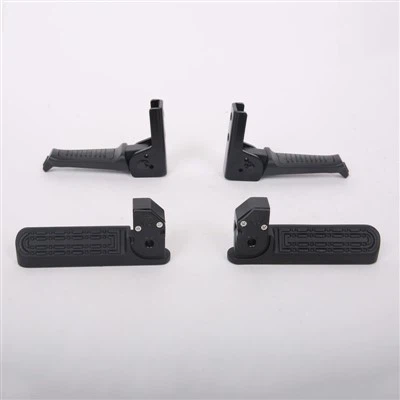
Hey there! As a supplier of Aluminum Alloy Forgings, I've got a ton to share about the quality control measures we implement. Aluminum alloy forgings are widely used in various industries, from automotive to aerospace, due to their excellent strength-to-weight ratio and corrosion resistance. But ensuring top-notch quality is no easy feat. Let's dive into the key steps we take to make sure our products meet the highest standards.
Raw Material Inspection
The quality journey starts right at the source - the raw materials. We work closely with trusted suppliers to source high-quality aluminum alloys. When the raw materials arrive at our facility, we conduct a thorough inspection. This includes checking the chemical composition of the alloy. We use advanced spectrometers to analyze the elements present in the material. A precise chemical composition is crucial as it directly affects the mechanical properties of the final forging.
We also examine the physical properties of the raw materials. This involves checking for any surface defects, such as cracks, pits, or inclusions. Even a small surface flaw can lead to problems during the forging process or in the final product's performance. We use visual inspection techniques, along with non-destructive testing methods like ultrasonic testing, to detect any hidden defects.
Forging Process Control
Once the raw materials pass inspection, it's time for the forging process. The forging process is a critical stage where we shape the aluminum alloy into the desired form. We carefully control the forging parameters, such as temperature, pressure, and deformation rate.
Temperature control is of utmost importance. If the temperature is too low, the alloy may not deform properly, leading to incomplete filling of the die and potential cracking. On the other hand, if the temperature is too high, the alloy may experience grain growth, which can weaken the final product. We use state-of-the-art heating equipment and temperature sensors to maintain the optimal forging temperature throughout the process.
Pressure and deformation rate also play a significant role. We use hydraulic presses with precise pressure control systems to ensure consistent and accurate forging. The deformation rate is carefully adjusted to avoid excessive stress on the material, which could cause internal defects.
In addition to these parameters, we also pay close attention to the die design and maintenance. A well-designed die is essential for producing high-quality forgings. We use computer-aided design (CAD) software to create precise die designs that meet the specific requirements of our customers. Regular die maintenance is also crucial to prevent wear and tear, which can affect the quality of the forgings.
Heat Treatment
After forging, the aluminum alloy forgings undergo heat treatment. Heat treatment is a process that involves heating and cooling the material to improve its mechanical properties. There are different types of heat treatment processes, such as annealing, quenching, and tempering, and we choose the appropriate process based on the specific requirements of the product.
During heat treatment, we carefully control the heating and cooling rates to ensure uniform treatment throughout the forging. This helps to eliminate internal stresses and improve the material's strength, hardness, and ductility. We also use advanced heat treatment furnaces with precise temperature control systems to ensure accurate and consistent results.
Machining and Finishing
Once the heat treatment is complete, the forgings may undergo machining and finishing processes to achieve the final dimensions and surface finish. Machining operations, such as milling, turning, and drilling, are carried out using high-precision machine tools. We use computer numerical control (CNC) machines to ensure accurate and repeatable machining results.
Surface finishing is also an important step to enhance the appearance and corrosion resistance of the forgings. We offer a variety of surface finishing options, such as anodizing, painting, and powder coating. These finishing processes not only improve the aesthetics of the product but also provide a protective layer against corrosion.
Non-Destructive Testing
Throughout the manufacturing process, we conduct non-destructive testing (NDT) to detect any internal or surface defects in the forgings. NDT methods are non-invasive and allow us to inspect the parts without causing any damage. Some of the commonly used NDT methods include ultrasonic testing, magnetic particle testing, and dye penetrant testing.
Ultrasonic testing is used to detect internal defects, such as cracks and porosity, by sending high-frequency sound waves through the material. Magnetic particle testing is used to detect surface and near-surface defects in ferromagnetic materials, while dye penetrant testing is used to detect surface defects in non-porous materials.
Final Inspection
Before the aluminum alloy forgings are shipped to our customers, we conduct a final inspection. This includes a visual inspection to check for any surface defects, dimensional inspection to ensure that the parts meet the specified tolerances, and mechanical property testing to verify the strength and hardness of the forgings.
We use a variety of inspection tools and equipment, such as calipers, micrometers, and hardness testers, to perform the final inspection. Any parts that do not meet our quality standards are rejected and either reworked or scrapped.
Continuous Improvement
At our company, we believe in continuous improvement. We regularly review our quality control processes and make adjustments as needed to ensure that we are always providing the highest quality products to our customers. We also collect feedback from our customers and use it to identify areas for improvement.
In addition to internal quality control measures, we are also committed to environmental sustainability. We use environmentally friendly manufacturing processes and materials whenever possible to minimize our impact on the environment.
Conclusion
In conclusion, quality control is a critical aspect of our business as a supplier of Aluminum Alloy Forgings. By implementing strict quality control measures at every stage of the manufacturing process, from raw material inspection to final inspection, we are able to ensure that our products meet the highest standards of quality and performance.
If you're in the market for high-quality aluminum alloy forgings, we'd love to hear from you. Whether you're looking for standard parts or custom-designed forgings, we have the expertise and capabilities to meet your needs. Feel free to reach out to us to discuss your requirements and start a partnership that will drive your business forward.

References
- ASM Handbook, Volume 14A: Metalworking: Forging
- Aluminum Association: Aluminum Forging Handbook
- Nondestructive Testing Handbook, Volume 1: Ultrasonic Testing
- ASTM International Standards for Aluminum Alloy Forgings