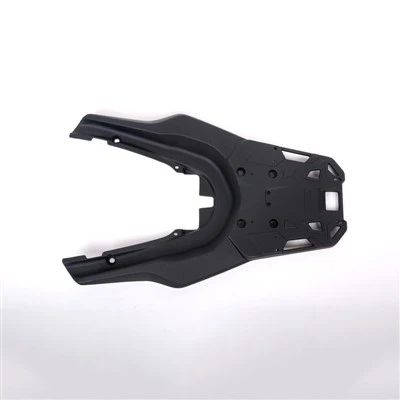
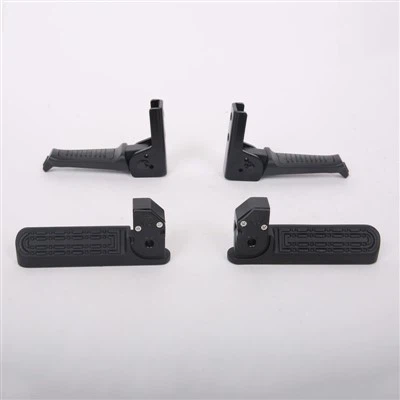
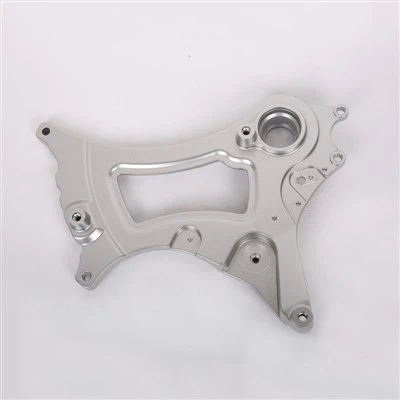
The dimensions of die castings mainly include the following:
Wall thickness: It is best to design the wall thickness uniformly. Uneven wall thickness is prone to shrinkage holes and cracks, which can easily cause deformation of parts and affect the service life of the mold. Shrinkage holes are prone to occur inside thick wall castings, affecting the mechanical properties of the material. For the outer edge wall thickness, in order to ensure good die casting, the wall thickness should be greater than or equal to 1/4h and greater than or equal to 1.5mm, where s is the edge wall thickness and h is the height of the edge wall.
Rounded corners: Rounded corners can make the molten metal flow smoothly and the gas can be easily discharged, which is conducive to the formation of castings, and can avoid cracks in parts and molds caused by sharp angles, which is conducive to improving the service life of the mold. The value principle of the fillet radius is as follows: for equal wall thickness, r should be between 1/2h and h; for unequal wall thickness, r should be between 1/4(h1+h2) and 1/2(h1+h2), where r is the inner fillet radius, and h, h1 and h2 are wall thicknesses.
Draft angle: The size of the draft angle is related to the structure, height, wall thickness and surface roughness of the part. Within the allowable range, it is best to take the largest value possible to facilitate demolding. The draft angle of the non-circular inner wall is as shown in the table below, and the outer side is half of the value in the table below.
Adjacent distance: Try to avoid narrow and deep cavity designs to avoid narrow and high bosses at the corresponding mold, which are easy to bend and break due to impact. The adjacent distance a should not be less than 5mm to ensure that the mold has sufficient strength.
Aperture and depth: There are certain restrictions on the aperture and depth of aluminum alloy die castings. The minimum aperture is 2.5mm. For blind holes, the hole depth is 3 to 4 times the aperture; for through holes, the hole depth is 6 to 8 times the aperture.
Shrinkage: Shrinkage refers to the percentage of size reduction when the alloy solidifies from liquid to solid. The shrinkage rate of aluminum alloy die castings is usually between 0.6% and 0.8%, and between 0.3% and 0.6% when hindered shrinkage occurs.